"The Torah is impossible."
That is how my student and colleague Rabbi Brett Kopin likes to put it. He does not mean the Torah is difficult, or that its composition is unlikely, or that its architecture is hard to believe. He is speaking of the amount of complex planning that went into the composition of the Torah: the sheer number of structural constraints operating in the text at the same time, at every level, from the individual cell to the five-book composition.
This overview will explain what drove him to that conclusion. It presents the architecture of the Torah level by level, from the interior of a single five-verse passage to a map of eighty-six literary units spanning five books — and beyond, to a hidden composition woven through all of them. At each level, new constraints appear, and every new constraint must be satisfied at the same time as all the ones that came before. By the end, the reader will be in a position to judge whether "impossible" is hyperbole or description.
Most readers who arrive at this analysis already know the Torah from the inside. They know how the stories move — from creation to the call of Abraham, from Egypt to Sinai, from the wilderness to the edge of the Promised Land. They know which names appear where, how the narrative builds, where it turns. That knowledge is not a liability here. It is the starting point.
What this overview will add is a second axis. The linear reading — from the first verse of Genesis to the last verse of Deuteronomy — remains true, and nothing in what follows cancels it. But the Torah, as this analysis will show, is organized along a second dimension that linear reading moves through without seeing: columns crossing its rows, rings nested inside its books, a hidden composition woven through all five books at once.
The experience of working through this material is something like learning that a text you have been reading left to right also reads top to bottom — and that both directions carry meaning at the same time. You already know the horizontal dimension. This overview introduces the vertical.
We begin with five verses.
A Grain of Sand
The best way to understand what the Torah's architecture is — and why it matters — is not to describe it from the outside but to experience it from the inside. So let us begin with five verses. Not a summary of findings. Not a map. Just five verses, read slowly, and see what happens.
Here is the first Word of the Decalogue — the first of the ten דברים (dvarim, "Words") spoken at Sinai, as divided by the Masoretic Text of the Torah scroll:
Five verses. A few seconds of reading. And yet this small passage turns out to contain a density of structural information that will take us a little while to unpack. But when we are done, you will have the key to reading the entire Torah — not just this passage, but all five books.
(The reasons for preferring this division of the Decalogue — which follows the Masoretic parashiyot of the Torah scroll rather than the Mekhilta — are set out in detail in the Decalogue article. There, the structural evidence for reading the ten Words as five pairs across two tablets is developed at length. Here, we focus on what the first Word reveals about the Torah's design method.)
As we work through the passage, we will keep a running count of structural elements. By the end of this overview, there will be fifty.
The Envelope 1
Notice, first, how the passage announces its own boundaries. It opens with אָנֹכִי יְהֹוָה אֱלֹהֶיךָ (Anokhi YHWH Eloheikha, "I am YHWH your deity"), and it closes with כִּי אָנֹכִי יְהֹוָה אֱלֹהֶיךָ (ki Anokhi YHWH Eloheikha, "for I am YHWH your deity"). The same phrase frames the entire unit. In between: three prohibitions. The structure is self-defining — it tells you where it begins and ends.
This is not a stylistic flourish. It is an architectural principle. A positive statement frames three negative commands. The same pattern appears throughout the Torah. Here, for example, is a passage from Deuteronomy 22:8–12:
(+) When you build a new house, you shall make a parapet for your roof…
(−) You shall not sow your vineyard with two kinds of seed…
(−) You shall not plow with an ox and an ass together.
(−) You shall not wear a mingled stuff, wool and linen together.
(+) You shall make yourself twisted cords upon the four corners of your covering…
Two positive commands frame three prohibitions. The structure is identical to the first Word: a positive envelope around a negative core. And the pattern is not limited to envelope structures. The Torah uses a variety of methods to define the boundaries of its literary units — toledot formulas, death notices, geographic markers, thematic refrains. What they share is the principle: the text itself signals where its units begin and end. That is the first structural element: self-defining boundaries.
Five Parts, Three Dimensions 2 3
Between the two occurrences of אָנֹכִי (Anokhi, "I"), the text divides into five distinct parts — the second structural element. Three things are happening within them at once.
First, time. The framework — parts (a) and (e), the two אָנֹכִי (Anokhi, "I") statements — spans from past to future. The opening looks backward: "who brought you out of Egypt" — history. The closing looks forward: "doing kindness to the thousandth generation" — prophecy. Between them, the three prohibitions are all in the present tense: what you must do now.
Second, person. The three prohibitions track through the grammatical persons. Part (b): "no other gods beside Me" — first person. Part (c): "you shall not make for yourself" — second person. Part (d): "you shall not bow down to them" — third person.
Third, space. At the very center — part (c), the middle of the middle — the text opens into physical space: "what is in the heavens above, or what is on the earth below, or what is in the waters beneath the earth."
| Content | Axis | |
|---|---|---|
| (a) | I am YHWH your deity, who brought you out of Egypt | Past |
| (b) | You shall have no other gods beside Me | 1st person |
| (c) | You shall not make for yourself any image — in the heavens above / on the earth / in the waters below | 2nd person / Space |
| (d) | You shall not bow down to them | 3rd person |
| (e) | For I am YHWH your deity … to the thousandth generation | Future |
Three nested dimensions. The ancient Sefer Yetzirah — perhaps the oldest extant book of Jewish esoterica — names them: שָׁנָה (shanah), time; נֶפֶשׁ (nefesh), person; עוֹלָם (olam), space. And all three converge at a single point: the center of the center of the center.
Past — Present — Future
Me — You — Them
Above — Earth — Below
You, here, now — the meeting point of the divine and the individual.
That is the third structural element: three axes of reality — time, person, space — nested inside the five-part sequence and converging at a single center point. Not just a commandment against idolatry: a complete model of reality, compressed into a structure small enough to hold in your hands.
Who Spoke 4
Now look at the verse that introduces these words. Exodus 20:1, properly speaking, is not part of the Decalogue — it is the narrator's frame:
And what is the first thing spoken? אָנֹכִי יְהֹוָה אֱלֹהֶיךָ — "I am YHWH your deity."
Notice the narrator's כָּל ("all"). The word is unnecessary — "And Elohim spoke these words" would suffice. Its force is: all of what follows, including the words spoken in YHWH's voice, came through Elohim. The narrator is drawing the reader's attention to the two-name problem before the speech even begins.
Read that again. The narrator tells you that Elohim spoke. The speech itself says "I am YHWH." The characters standing at Sinai — Moses and the people — hear only the speech: YHWH revealing himself. But you, the reader of the written text, are given something the characters do not have: the narrator's identification of who is speaking. And the narrator says Elohim.
This matters because it means the Torah is more than a record of what happened at Sinai. A historical account would give you the speech and let you stand where the people stood. This text does something else: it gives its audience information that the characters in the story cannot access. It operates on more than one level. Two divine names, two channels of information, right here at the threshold of the Decalogue. Something that operates most visibly in Genesis — from the call of Abraham (Unit 5) onward — where the pattern of divine appearances on stage by row position is measurable and consistent. That is the fourth structural element: the Elohim/YHWH split.
The Grain and the Tapestry
Why spend so long on five verses? Because something worth pausing for has just happened.
In a passage that occupies a fraction of a stone tablet, we have found four dimensions of meaning: a self-defining envelope structure; a five-part division; three nested dimensions — time, person, space — converging at a single center point; and two divine names operating on two channels of information. All of this, at the same time, in the same five verses.
That is a feat of information management that deserves attention. The author of this text was not simply recording commandments or telling a story. The author was encoding multiple layers of meaning into a single passage, so that the same words carry different meaning depending on which axis you read along — the temporal, the personal, the spatial, the structural. Finite text, carrying far more information than any one reading can extract.
This is the discovery that the Torah Weave commentary is built to explore. The author of the Torah was a master of information compression — embedding level upon level of structure into the same words. What we have just seen in five verses, the commentary will show operating at every scale of the Torah. But four elements is not the end. The first Word does not stand alone.
The Prototype
We have looked inside the first Word and found four structural elements: envelope, five-part sequence, three nested dimensions, and the Elohim/YHWH split. All of that came from reading the passage on its own terms. But the first Word does not stand alone. It sits inside a table. And the table has more to teach.
Rings Within the Word 5
Look again at the five parts, but now notice how they pair. Parts (a) and (e) are the envelope — both open with אָנֹכִי. Part (a) looks to the past: "who brought you out of Egypt." Part (e) looks to the future: "to the thousandth generation." They frame the passage in time.
Parts (b) and (d) are also paired. Part (b): "no other gods beside Me" — first person. Part (d): "do not bow down to them" — third person. Both are prohibitions against idolatry, but the grammatical person shifts from the deity's "Me" outward to "them." They frame the passage in person.
And part (c) stands at the center, alone: the spatial triad of heavens, earth, and waters below.
| Ring | Parts | Content |
|---|---|---|
| Outer ring | (a) ↔ (e) | Time: past ↔ future |
| Middle ring | (b) ↔ (d) | Person: Me ↔ them |
| Center | (c) | Space: above / earth / below |
The five parts are not just sequential. They are concentric — an outer ring, a middle ring, and a center. This is a structure we will encounter again and again as we move through the Torah's architecture.
The Same Structure, a Different Center 6
Is this pattern unique to the first Word, or is it a principle? We can check. The Sabbath command — Word 2A, the first Word of the second pair — also divides into five parts:
| Content | |
|---|---|
| (a) | Remember the Sabbath day, to sanctify it |
| (b) | Six days you shall labor and do all your work; the seventh day is a Sabbath to YHWH your deity |
| (c) | You shall not do any work — you, your son, your daughter, your manservant, your maidservant, your animal, the stranger within your gates |
| (d) | For in six days YHWH made the heavens and the earth, the sea and all that is in them, and rested on the seventh day |
| (e) | Therefore YHWH blessed the Sabbath day and sanctified it |
The concentric pairing is immediate. Parts (a) and (e): you sanctify the Sabbath; YHWH sanctified the Sabbath. Human act mirrors divine act. Parts (b) and (d): six days you work and rest on the seventh; six days YHWH made heaven and earth and rested on the seventh. Human labor mirrors divine labor. And part (c) stands at the center: a list of persons radiating outward from "you" through family, servants, animals, to the stranger at your gates.
The five-part concentric structure is not an accident of one passage. It recurs. But the content of the center shifts. In Word 1A — the deity's self-revelation — the center is space. In Word 2A — the command addressed to human beings — the center is person. Both are framed by time. The three dimensions from Sefer Yetzirah are not confined to the first Word. They are distributed across the table. The content of each Word is shaped by its position in the structure.
The Table 7
This brings us to the table itself. The Decalogue was not written as a list. It was inscribed on two tablets — and the Torah specifies that the writing ran across both sides: מִזֶּה וּמִזֶּה הֵם כְּתֻבִים, "on one and on the other were they written" (Exodus 32:15). The ten Words alternate from one tablet to the other, forming five pairs across two columns.
| Pair | Tablet A | Tablet B | Subject |
|---|---|---|---|
| 1 | I am YHWH your deity… | Do not take the Name in vain | The Deity |
| 2 | Remember the Sabbath | Honor your father and mother | Divine will |
| 3 | Do not murder | Do not commit adultery | Physical life |
| 4 | Do not steal | Do not bear false witness | Property and law |
| 5 | Do not covet your fellow's house | Do not covet your fellow's wife… | Subjective desire |
Read the rows: each pair addresses a single subject, from the most encompassing — the deity — to the most private — an emotion. The hierarchy descends from the infinite to the interior without interruption. Read the columns: Tablet A concerns the one, the separate, the intrinsic. Tablet B concerns the many, the connected, the extrinsic. In Pair 5, where both Words prohibit the same act — coveting — the distinction is clearest: 5A has a single object ("your fellow's house"), 5B has many ("wife, manservant, maidservant, ox, donkey, and all that is your fellow's").
The first Word has now acquired a seventh structural element. It is not only a self-contained passage with five internal layers of meaning. It is also a cell in a table — positioned in Row 1 (the deity) and Column A (the one, the intrinsic). Its content is determined by that intersection. The self-revelation of the deity as a singular "I" is precisely what belongs at the intersection of "the deity" and "the one." The table is a coordinate system, and the content at each point is a function of two variables: row pairing and column hierarchy.
Vertical Resonance 8
But the table reveals something else — an eighth structural element. Look at where the first Word sits and what it says. The deity in Row 1 declares itself אֵל קַנָּא (El Kana), a jealous deity. And what sits at the bottom of the same table? Row 5: the prohibition against coveting, where human beings must restrain their desire. Pairs 1 and 5 both describe emotive beings: the most infinite subject in the hierarchy (the deity) and the most private (an emotion) turn out to share the same register. And a single word runs down Tablet A. Word 1A begins with the deity who brought Israel out of the house of bondage, בֵּית עֲבָדִים; Word 5A ends with the prohibition against coveting your fellow's house, בֵּית רֵעֶךָ. The top of the table and the bottom of the table meet in the same word. That is vertical resonance.
Structural elements identified so far: 8
Eight dimensions from five verses. If that seems like a great deal to locate in a single passage, it is — and the density is not accidental. It is the clearest single demonstration of the Torah's method — and not by accident. The Decalogue is presented in the text as the deity's own composition: spoken by Elohim at Sinai, then inscribed by the divine hand on stone. The same Elohim who created the world as a woven structure authored this passage. The Decalogue is the paradigm not because it happens to exhibit good organization, but because it comes directly from the architect of the weave.
Each element we have identified here — the self-defining envelope, the concentric ring structure, the coordinate logic of rows and columns, the two-channel information carried by the divine names — will appear again at every scale we examine. When it does, the terminology will already be familiar. The list of structural elements will keep growing. By the end, the same analytical vocabulary that unlocked five verses will have unlocked eighty-six units across five books.
What comes next is a widening out. We move from the grain of sand to the tapestry.
And the Decalogue is only the prototype. The Torah claims it was written by the deity's own hand, on two tablets — the original woven text. All eighty-six literary units of the Torah are built on the same principle: text organized in two dimensions, carrying meaning along every axis at the same time. We turn now to the building blocks of that architecture.
(For the full analysis of the Decalogue as a 5×2 table, see "Divine Speech in Two Dimensions" and the visual presentation of the Decalogue. The correspondence between the five pairs and the literary structure of Tractate Avot is set out in "The Esoteric Decalogue".)
A Microcosm of Five Books 9
The five-part structure of the first Word is not only a model of the three dimensions of reality. It maps directly onto the five books of the Torah.
Part (a), the opening אָנֹכִי, looks to the past: "who brought you out of the land of Egypt." This is the perspective of Genesis — the book of origins. It begins with the creation of the world and ends with a family descending into Egypt. The entire narrative arc is retrospective: where did we come from?
Parts (b), (c), and (d) — the three prohibitions — are all in the present tense. They correspond to the three central books: Exodus, Leviticus, and Numbers. The action of these books takes place within the forty years between the departure from Egypt and the entry into the Land. Exodus tells the story of liberation and Sinai. Leviticus legislates holiness at the center. Numbers narrates the wilderness journey. Together, they are the present tense of the Torah — the "now" of the covenant.
Part (e), the closing אָנֹכִי, looks to the future: "doing kindness to the thousandth generation." This is the perspective of Deuteronomy — Moses' farewell speeches, delivered on the threshold of the Promised Land, looking forward across all the generations to come.
But the parallel runs deeper than the temporal arc. Look at the three middle parts more carefully. Parts (b) and (d) are directly related: "no other gods beside Me" and "do not bow down to them" address the same subject — idolatry — from two angles. They form a pair. And part (c) comes between them, interrupting the pair with the spatial triad of heavens, earth, and waters below. This is exactly the relationship among the three middle books: Exodus and Numbers form a narrative pair, and Leviticus sits between them, interrupting the narrative flow with something structurally different. Leviticus is the center of the Torah just as part (c), with its three-dimensional spatial opening, is the center of the first Word.
And the correspondence goes one step further. Part (c) contains three vertical levels: heavens above, earth below, waters beneath the earth. Leviticus, too, is organized in three vertical levels — its twenty-two units structured as a journey through the Tabernacle, three stages going in toward the center and three coming back out. As Mary Douglas observed, the Tabernacle is Sinai laid on its side: the horizontal movement from courtyard to inner sanctum maps onto the vertical ascent of the mountain. Three spatial levels at the center of the first Word; three spatial levels at the center of the five books. The same architecture, at two scales.
The smallest literary unit of the Decalogue carries within it the shape of the whole. We turn now to that whole.
Structural elements identified so far: 9
The Full Torah Map
Below is a representation of the complete Torah Weave Map, showing all eighty-six units across five books in their structural positions. The horizontal thread runs left to right (Genesis–Leviticus–Deuteronomy); the vertical thread runs top to bottom (Exodus–Leviticus–Numbers). Leviticus sits at the intersection, belonging to both threads. The seven unique units — those that are not grouped with other units and serve as dividers — are marked with a red border.
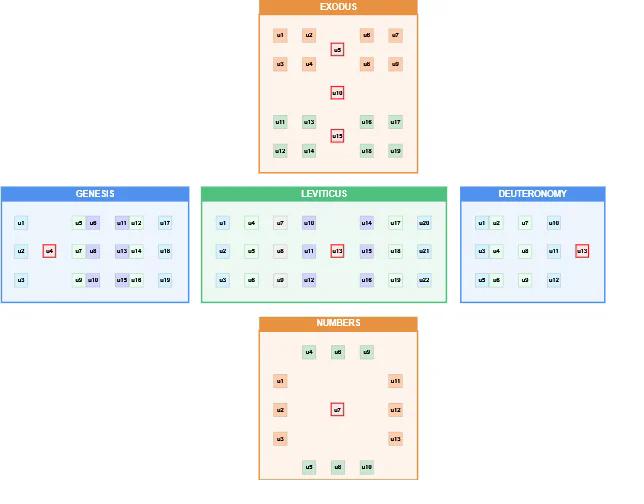
The map makes visible what sequential reading cannot. Genesis and Deuteronomy flank Leviticus on the horizontal axis. Exodus and Numbers flank Leviticus on the vertical axis. Leviticus belongs to both threads and binds the entire composition together. The unique units divide the two threads at structurally necessary points.
Reading the Map
The map rewards slow looking. Each level of visible order corresponds to a level of literary organization in the text. Begin with the largest features and work inward.
Five books, two threads. 10 The first thing the eye registers is five rectangles arranged where a horizontal and a vertical thread intersect. Three books run left to right — Genesis, Leviticus, Deuteronomy. Two books run top to bottom — Exodus above, Numbers below. Leviticus sits at the intersection, the only book that belongs to both threads. This is not a filing system. It is the composition's fundamental geometry: a warp thread and a weft thread meeting at a single point.
Symmetry across the axes. 11 Genesis and Deuteronomy, at the ends of the horizontal thread, mirror each other — same shape, same number of rows. Exodus and Numbers, at the ends of the vertical thread, mirror each other — same shape, same number of quadrant divisions, same structural logic. The Torah is not a sequence of five books. It is a symmetric composition in which corresponding books illuminate each other across the threads.
Numerical balance. 12 The symmetry extends to the unit counts. Genesis contains 19 units and Deuteronomy 13; together, the two outer books of the horizontal thread hold 32 units. Exodus contains 19 units and Numbers 13; together, the two outer books of the vertical thread also hold exactly 32 units. Leviticus, at the center, contains 22. The composition balances perfectly around its intersection point: 32 on each arm, 22 at the center.
Two book formats. 13 The three horizontal books — Genesis, Leviticus, Deuteronomy — are wide and shallow: three rows of units running across. The two vertical books — Exodus and Numbers — are square, with units arranged in four quadrants rather than three rows. The shape of the rectangle tells you something about the literary structure of the book it contains.
Eighty-six units. 14 Inside the rectangles sit eighty-six literary units — each one a self-contained composition of prime pericopes organized as a two-dimensional table. This is the Torah's basic currency. The five books are not divided into chapters (a medieval invention) or even into weekly reading portions. They are composed of these units, and the units are what the architecture is built from.
Three rows in the horizontal books. 15 In Genesis, Leviticus, and Deuteronomy, the units sit at three distinct vertical positions — three rows. The rows carry different thematic registers, and in Genesis — from the call of Abraham (Unit 5) onward — they also carry different patterns of divine appearance. In Row 1, YHWH appears as the active subject — speaking or described by the narrator as acting. In Row 3, Elohim appears as the active subject. In Row 2, both appear on stage. The rows are warp threads stretched across the horizontal books, derived from the three cosmic levels of the creation narrative: heavens, intermediate space, earth.
Quadrants in the vertical books. 16 Exodus and Numbers are organized differently. Instead of three rows, each book divides into four quadrants. In Exodus, the four quadrants are created by the three unique units that divide the book into equal segments. In Numbers, the four-quadrant structure mirrors the physical arrangement of the Israelite camp: four groups positioned around a center. This is the quadratic format that the Torah as a whole also exhibits — the map itself is a quadratic composition with Leviticus at its center.
Five vertical levels. 17 Now look at the map as a whole, from top to bottom. The three rows running through the horizontal books sit in the middle band. Above them, Exodus. Below them, Numbers. The five-part structure of the first Word of the Decalogue reappears here at the scale of the entire Torah. The opening אָנֹכִי (Anokhi, "I") identifies the deity as the one who redeemed Israel from Egypt; the closing אָנֹכִי (Anokhi, "I") warns of punishment reckoned across generations. Between them stand three elements distinguishing the deity-side, the interface, and the human-side. Just as the three prohibitions of the first Word form a coherent block — not three separate commandments but a single, internally differentiated statement about the relationship between Israel and the divine — so the three rows of the horizontal books form a coherent system. They are not simply a middle band. They constitute a unified structure whose three positions are meaningfully distinct from one another and from the books that frame them. Exodus and Numbers stand at the outside: two moments of divine intervention in history, one of redemption, one of punishment. Between them, the three rows of the horizontal books span the full range of human existence through the Torah's covenantal perspective. The two books and the three rows differ not only in position but in kind. That makes five vertical levels: Exodus at the top, then Row 1, Row 2 (the interface), Row 3, and Numbers at the bottom. The map does not merely contain the pattern. The map is the pattern, at the largest scale.
Unique units. 18 Seven units stand apart, marked with a red border on the map. These are the seven unique units, which are not grouped with other units and serve as the composition's dividers: the Babel narrative (Genesis Unit 4), three pivot units in Exodus (Units 5, 10, 15), the center of Leviticus (Unit 13: "You shall be holy"), the center of Numbers (Unit 7), and the conclusion of Deuteronomy (Unit 13).
In the horizontal thread, the unique units mark beginning, middle, and end. In the vertical thread, they are all at the center — creating the four quadrants of Exodus and Numbers, fixing each book's position in the weave. Remove them and the composition falls into disconnected pieces. The composition signs its own seams.
Structural dividers. 19 The unique units are the Torah's dividers, and their work is most visible in Exodus. There the three unique units (Units 5, 10, 15) divide the book into four equal segments of four units each. They do not merely occupy significant positions; they create the quadrant structure of Exodus by dividing it. This role, creating structure through division, is a class of architectural function in its own right.
Structural elements identified so far: 19
Inside the Books
The map shows five books woven on two threads. Now look inside them. Each book is not a sequence of units but a composition with its own internal architecture — and the architecture differs depending on which thread the book belongs to.
Outer frame triads. 20 In the horizontal books, the first and last unit-sets frame everything between them. Genesis opens with three units (1–3) that move from universal to particular: creation, then the narrowing of the human line, then the Flood and its aftermath. Genesis closes with three units (17–19) that move from particular back to universal: Joseph's rise, the famine that brings all the earth to Egypt for grain, and the blessings and deaths that close the book. The opening triad faces inward, contracting toward the chosen family. The closing triad faces outward, expanding toward all nations. Deuteronomy exhibits the same framing architecture. The outer frames are not introduction and conclusion. They are the book's own envelope — a structure we already saw operating at the scale of five verses in the first Word.
Concentric rings. 21 Between the outer frames, units organize concentrically — not as a sequence but as nested rings, each with its own thematic register. Leviticus makes this most visible. Its twenty-two units form three concentric rings around a center. The outer ring (Units 1–3 paired with 20–22) is marked by references to the place of revelation. The middle ring (Units 4–6 paired with 17–19) is marked by time — specifically the pattern "seven days… on the eighth day." The inner ring (Units 10–12 paired with 14–16) is marked by person — extensive lists of family relationships. Place, time, person: olam, shanah, nefesh — the three dimensions of Sefer Yetzirah, which we already found converging at the center of the first Word. The same three categories organize the rings of the central book.
Anomalous units. 22 In each ring of Leviticus, one unit lacks the ring's characteristic. And the anomalous units all occupy the same position: the middle of the first triad in each ring. This regularity means the anomaly is itself structural — it is a designed absence, not an error. The pattern has a precedent at a different scale: Day 2 of creation is the only day that lacks the formula "and it was good." In both cases, the composition marks a specific position by withholding what the others share. The absence is the signal.
The Tabernacle journey. 23 The concentric rings of Leviticus map directly onto the Tabernacle. The outer ring corresponds to the courtyard — the accessible space. The middle ring corresponds to the Holy Place — the zone of ongoing ritual. The inner ring corresponds to the Holy of Holies — the space of intimate presence. Reading Leviticus from outside inward replicates the priest's physical movement through the sacred structure. The book is a literary Tabernacle.
The triad orientation flip. 24 Within a triad, the three units carry a hierarchical orientation: one faces toward the transcendent, one toward ordinary life, one mediates. In Genesis, the first unit of each triad is deity-oriented and the third is people-oriented. In Deuteronomy, this orientation reverses: the first unit is people-oriented and the third is deity-oriented. Leviticus bridges both orientations. Its first half (before Unit 13) follows the Genesis pattern; its second half follows the Deuteronomy pattern. Unit 13 — "You shall be holy" — is the pivot point where the flip occurs. Leviticus does not simply sit between Genesis and Deuteronomy on the map. The three horizontal books are themselves a triad — Genesis deity-oriented, Deuteronomy people-oriented, and Leviticus the middle that mediates between them.
The camp structure of the vertical thread. 25 The three vertical books — Exodus, Leviticus, Numbers — compose as a single spatial block whose organization replicates the Israelite camp. At the absolute center stands Leviticus Unit 13 — "You shall be holy" — the literary equivalent of the Ark of the Covenant, the point of the divine presence. Around it, the three concentric rings of Leviticus: the inner ring (Units 10–12 and 14–16), corresponding to the Holy of Holies; the middle ring (Units 4–6 and 17–19), corresponding to the Holy Place; and the outer ring (Units 1–3 and 20–22), corresponding to the courtyard. Surrounding Leviticus: the Levitical precinct — the second half of Exodus and the beginning of Numbers, concerned with Tabernacle construction and maintenance. Surrounding that: the first half of Exodus and the second half of Numbers, carrying the historical narrative of the Israelite camp's journey. All five zones are concentric, centered on Leviticus Unit 13. The vertical thread does not merely describe the camp. It is the camp.
Self-depicting books. 26 This identity of form and content extends to individual books. Leviticus is structured as the Tabernacle it legislates. Numbers is arranged as the camp it describes — four sides around a center, with the flag-tribe units positioned at the centers of the four sides, exactly where the banner tribes stand in the camp layout. The book does not just contain the information. It is what it describes.
Self-referencing centers. 27 In both Leviticus and Numbers, the center unit describes the principle that governs the book's own architecture. Leviticus Unit 13 — "You shall be holy, for I YHWH your deity am holy" — sits at the center of a book structured as the Tabernacle, the place where the divine presence dwells in the human world. The center commands what the structure embodies. Numbers Unit 7 commands tassels (tzitzit) on the sides (kanaf) of garments to remember all the commandments — and the book places law-bearing flag units on its sides. The center unit is the key to the architecture it sits inside.
Structural elements identified so far: 27
Unit-Sets and Triads
Inside each book, units do not stand alone. They cluster into groups — and the grouping carries information.
Shared format. 28 In the triadic books, units group in threes. In Leviticus, Units 1–3 are all 3×3 grids; Units 4–6 are all 2×2 grids. The format is not visible from linear reading — it emerges only when the two-dimensional structure of each unit is mapped.
Paired triads. 29 Triads do not stand alone either. They pair with other triads to form the concentric rings described above — one triad on each side of the center. All three horizontal books — Genesis, Leviticus, and Deuteronomy — are composed entirely of paired triads. Every triad in the composition has a partner, with one exception: the impurities triad in Leviticus, which stands outside the paired structure. Across three books and dozens of triads, a single unpaired triad. The exception confirms the rule.
Block centers. 30 The same units that compose as concentric rings can also be read as two blocks of nine — two halves of a book, each with a center unit at its fifth position. In Genesis, the center of the first half (Unit 7) holds the two covenants between Abraham and YHWH and between Abraham and Elohim. The center of the second half (Unit 14) holds the ladder vision — the point where the two divine registers meet between heaven and earth. Two covenants at one center, a bridge between them at the other. The block reading and the ring reading coexist, extracting different information from the same arrangement.
Hierarchical orientation. 31 Within each triad, the three positions carry a directional order derived from the creation narrative. One unit faces toward the transcendent (the row where YHWH appears on stage), one faces toward ordinary life (the row where Elohim appears on stage), and one mediates between them. This is not a thematic label applied after the fact. It is visible in the pattern of divine appearances on stage: in Genesis from the call of Abraham (Unit 5) onward, the deity appears as YHWH in the first unit of each triad, as Elohim in the third, and as both in the second — either speaking in that name or described by the narrator under that name. The pattern is measurable.
Alternating tracks. 32 Not all triads do the same work. In Genesis, triads alternate between two tracks — one concerned with covenant (the promises and obligations that define the vertical relationship between the deity and the chosen line) and one concerned with family (the horizontal relationships between siblings, spouses, and generations). The alternation means that adjacent triads address different dimensions of the narrative, and the reader moves back and forth between them.
Track inversion. 33 The assignment of odd and even triads to tracks flips between the two cycles of Genesis. In the Abraham cycle, the triad of odd-numbered units (5, 7, 9) carries the covenant material. In the Jacob cycle, the triad of even-numbered units (12, 14, 16) carries it. The inversion is systematic — it is not a disruption of the pattern but part of the pattern, creating a chiastic relationship between the two halves of the book.
Non-linear reading order. 34 Because units are assigned to rows, the triads do not read as consecutive blocks. Units 5, 7, and 9 form a triad — not 5, 6, and 7. The reader must skip, reading by row position rather than by sequence number. The linear numbering masks the actual groupings. This is the principle that operates at every scale of the Torah: consecutive numbering conceals non-linear structure.
Structural elements identified so far: 34
Inside the Unit
We have moved from the five-book composition down through book-level architecture to unit-sets and triads. The next level is the unit itself — what does it look like inside?
The two-dimensional table. 35 Each unit is not a linear sequence of passages but a table — a grid of cells organized by rows and columns. Consider the opening of Leviticus. Most readers find these chapters difficult: detailed instructions for sacrifices, one type after another, in language that feels technical and remote. But the difficulty dissolves when you see the structure. The first unit (Leviticus 1:1–3:17) contains nine passages organized as a 3×3 grid:
| A (most costly) | B | C (least costly) | |
|---|---|---|---|
| Row 1 | Burnt-offering from the herd | Burnt-offering from the flock | Burnt-offering from birds |
| Row 2 | Meal-offering of flour | Meal-offering baked | Meal-offering of first-fruits |
| Row 3 | Peace-offering from the herd | Peace-offering from sheep | Peace-offering from goats |
Read across any row and you see one offering type in three variants — from the most costly source to the least. Read down any column and you see three different offerings at the same value level. The text carries different information depending on which axis you read along. It is a table, just as the Decalogue is a table.
Unit format. 36 The number of rows and columns is not arbitrary. It is the unit's format. In Leviticus, Units 1–3 are all 3×3; Units 4–6 are all 2×2. Different formats serve different kinds of material — a 3×3 grid suits three offering types in three grades; a 2×2 grid suits a simpler binary distinction.
Prime pericopes. 37 Each cell in the table is a prime pericope — a self-contained passage of text with its own opening formula and closing marker, functioning as an element in a two-dimensional composition. The prime pericope is to the literary unit what the individual Word is to the Decalogue: a cell whose meaning is shaped by its row and column. In Leviticus Unit 1, the cell at Row 1, Column A must present the burnt-offering from the herd — Row 1 gives it the offering type, Column A gives it the most costly variant. The content at each position is a function of two coordinates.
Row logic. 38 Within a unit, the rows organize material by type — kinds of offering, categories of law, stages of narrative. Each row carries one complete category across all columns. The row is a horizontal thread at the unit level, just as the three rows of the horizontal books are threads at the composition level.
Column logic. 39 The columns organize the same material by a different axis — scale, value, cost, or addressee. In Leviticus Unit 1, Column A holds the most costly variant of each offering, Column C the least. The column carries information that the row does not. The two axes are independent: change the row and you change the category; change the column and you change the grade. The reader who follows the text linearly encounters a list. The reader who sees the table encounters a coordinate system.
Discoverable structure. 40 There is a difference between the Decalogue and the rest of the Torah. The Torah tells you that the tablets were inscribed "on one side and on the other" — a description that hints at two-dimensional reading. For the Torah's own literary units, you do not get that hint. On a scroll, one pericope follows the next in sequence. The two-dimensional structure must be discovered from the text itself: repeated phrases that link one cell to another across columns, vocabulary that threads through an entire row, envelope markers that define where each pericope begins and ends. The text teaches you how to read it — but only if you are listening for the architecture.
Structural elements identified so far: 40
The Weave Markers
The discoverable structure just described raises a practical question: what exactly does the reader look for? The Torah Weave commentary identifies five kinds of literary marker, shown in eight colors, each making visible a different axis of the two-dimensional composition. Together, they are the evidence that the tables exist.
Horizontal parallels. 41 Repeated words, phrases, or formulas that link cells across the same row. The commentary marks three kinds: words shared by all the cells of a row; words shared by the first and second cells; and words shared by the second and third, so that the middle cell carries both and shows itself as the conceptual middle. These are the markers that make the row visible as a continuous thread. When the same opening formula appears in three consecutive pericopes, or when a distinctive Hebrew term recurs in each column of a single row and nowhere else, the reader can see that these passages belong together horizontally. The row is not an imposed category. It announces itself through shared vocabulary.
Vertical threads. 42 Repeated words or motifs that link cells down a single column — connecting Row 1 to Row 2 to Row 3. These make the column visible as a continuous axis. When a word or phrase repeats in several cells of the same column, it is a vertical thread — stitching the rows together at that position. The vertical thread is what distinguishes a table from three unrelated rows: it shows that the columns carry their own information independent of the rows.
Envelope closures. 43 Matching words in the first row and the last row of a unit, forming an envelope that encloses the whole unit. We already saw the first Word of the Decalogue open and close with "I am YHWH your deity." The same technique operates at every scale: a pericope announces its boundaries, a unit frames itself. The envelope closure is the self-defining boundary seen from inside the weave.
Chiastic connections. 44 Links that cross the unit diagonally, in the shape of an X. One links the first cell of the first row with the last cell of the last row (upper left with lower right); the other links the last cell of the first row with the first cell of the last row (upper right with lower left). Each is half of the chiasm. Chiasm is the literary structure of reversal: ABBA rather than ABAB.
Internal parallels. 45 Parallels between parts of a single cell, linking passages inside one pericope rather than one cell to another. These are the finest threads in the weave, often visible only after the primary horizontal and vertical connections have been mapped.
These five marker types are not interpretive categories. They are observable features of the Hebrew text — specific words recurring in specific positions. The Torah Weave commentary color-codes them so the reader can see the architecture the author built. Together, they turn a linear scroll into a readable table.
Structural elements identified so far: 45
Two Questions
By this point, a careful reader will have raised two objections. Both deserve a direct answer before we continue.
The first: Is this analysis discovering patterns, or constructing them? Any text long enough will contain repetitions. When we identify "grids" and "tables" in the Torah, are we seeing what the author built — or what we brought with us?
The question is fair. The answer lies in what the markers can predict.
The five marker types identified above — horizontal parallels, vertical threads, envelope closures, chiastic connections, internal parallels — are not interpretive judgments. They are specific Hebrew words appearing in specific positions. Whether they appear is verifiable; any reader of the Hebrew can check. The question is not whether the repetitions exist. The question is whether they are random or structured.
Here the pattern of divine appearances on stage offers the clearest available answer. In Genesis — from the call of Abraham (Unit 5) onward — YHWH and Elohim do not appear at random across the narrative. The deity appears under one name or the other in predictable positions: as YHWH in Row 1 units, as Elohim in Row 3 units, as both in Row 2 units — consistently, across both the Abraham and Jacob cycles. The appearance is counted only when the deity acts directly: speaking in that name or described by the narrator as acting under it. A human character invoking a name does not count. And it means that knowing a unit's row position predicts which divine character will appear on stage — before you read the unit.
A stylistic habit does not generate predictions. A structure does.
The second objection is sharper. The analysis describes itself as purely literary — examining compositional technique rather than making claims about authorship or origin. Yet it calls the text "impossible" and invokes the image of the deity inscribing stone tablets. Isn't that a conclusion about authorship dressed in literary language?
What "purely literary" means here is precise: the fifty structural elements identified in this overview are features of the Hebrew text as it stands. They can be mapped, counted, and verified without taking any position on who composed the text, under what circumstances, or by what means. Whether the architect was a single author, a school of redactors working across centuries, or — as the Torah itself claims — the deity whose hand inscribed the tablets: the analysis does not adjudicate. It describes what is there.
"Impossible" is one reader's reaction to the density of what is there. Whether you share that reaction, and what you make of it if you do, is a question each reader answers for themselves. The literary analysis stops at the text.
Cross-Cutting Patterns
The structures described so far operate within a single level — the map, the book, the triad, the unit, the cell. But the Torah also contains patterns that cut across levels, linking units to other units and books to other books.
Divine appearances on stage by row. 46 In Genesis — from the call of Abraham (Unit 5) onward — the deity's appearances on stage distribute systematically by row position. In Row 1 units, the deity acts or speaks as YHWH. In Row 3 units, the deity acts or speaks as Elohim. In Row 2 units, both appear. The count includes only direct appearances: divine speech or narrative description of divine action. A human character invoking a name does not qualify. This pattern is not a tendency. It is measurable and consistent across both the Abraham and Jacob cycles. The row assignment of a unit predicts which divine character will appear on stage. The two are not interchangeable. Their appearances are structurally assigned.
Corresponding units. 47 Units that occupy the same position in parallel cycles correspond to each other — and the correspondence is not just positional but substantive. In Genesis, the unit at a given row and track position in the Abraham cycle shares narrative material, thematic concerns, and verbal echoes with the unit at the same position in the Jacob cycle. The same story is being told twice, from two different angles, and the structure makes the correspondence visible. The reader who knows one cycle can anticipate features of the other.
Verbal cross-references. 48 Units that correspond structurally also reference each other textually. Distinctive vocabulary, unusual phrases, or explicit narrative callbacks link one unit to its counterpart. These are not accidental echoes. They are the author's way of confirming the structural correspondence — a textual signature that says: these two units know about each other. The cross-references operate between cycles within a book, between paired triads within a ring, and between corresponding positions across books on the same thread.
Creation days as structural blueprint. 49 The six days of creation in Genesis Unit 1 are organized as two triads: Days 1–3 and Days 4–6. The days pair across the triads (Day 1 with Day 4, Day 2 with Day 5, Day 3 with Day 6), and the pairing follows a hierarchy — from the most encompassing (light, luminaries) to the most particular (dry land and vegetation, land animals and humans). This same pattern — two paired triads with a hierarchical orientation — is the organizing principle of triads throughout the Torah. The creation narrative is not just the first story the Torah tells. It is the template on which the Torah's architecture is built.
The re-creation weave. 50 The ten irregular units are spread across all five books, from Genesis Unit 13 to Deuteronomy Unit 1. Their weft threads vary in size, yet they keep a form of symmetry: in all ten, the first and last weft threads are the same size. Every word of the ten belongs to the linear reading; they stand in their places within the regular text. Read together, they tell a story of their own: how YHWH, the transcendent, is revealed within Elohim's natural world, through holiness, through Israel, through the land. This composition is the subject of The Sixth Book of the Torah.
Structural elements identified so far: 50
Fifty elements. We have moved from a five-verse passage to a hidden composition running through all five books. Before we take the final step — asking what all of this means for a single passage in the text — a word on what fifty elements does and does not claim.
It does not claim that linear reading is wrong or that it fails to find real meaning. The narrative meanings available to a reader moving sequentially from Genesis to Deuteronomy are genuine. The structural analysis does not replace them. What it adds is a different kind of access — gates into the text that the linear reading passes through without opening. The columns, rings, and cross-book correspondences were always there. The structural analysis makes them visible.
The question the seven levels now address is: when a reader encounters a single verse, how many of these structural levels are operating on it at the same time? The answer turns out to be the most direct demonstration of what "density" means in this context.
Seven Levels
We have seen how a prime pericope works: a passage of text functioning as a cell in a table, its content shaped by two coordinates — row and column. But we have not yet asked the most basic question: what exactly constrains the content of any given cell? What is pressing on it from every direction at once? The answer is that each level of organization adds new constraints, and by the time you reach the top, the same words are doing work along multiple axes simultaneously. The structure is cumulative. We can count the levels.
Now consider what this means for the text itself. A single prime pericope — say, the burnt-offering from the herd in Leviticus 1:3–9 — is constrained simultaneously by its row within the unit, its column, its unit's format, its position in a triad, the triad's hierarchical orientation, its ring's thematic marker, the book's literary journey, its thread's cross-book pattern, and the structures that run through the whole Torah. Change a word in that pericope and you risk breaking the row connection, the column gradient, the format regularity, the triadic hierarchy, the ring marker, the book's progression, and the thread's correspondence — all at once.
This is what we mean by density. The text is finite — a fixed number of Hebrew words. But the information it carries is not fixed at one reading. Each level of organization extracts different information from the same words. The linear reader encounters a sequence of instructions about animal sacrifice. The structural reader encounters a nine-dimensional coordinate system in which every word is doing work along multiple axes at the same time. The words do not change; the reading does.
Conclusion
We began with five verses — a grain of sand. Inside it we found eight dimensions of meaning operating at the same time: envelope, five-part sequence, three nested dimensions, two divine names, concentric rings, a center that shifts from Word to Word, a place in a table of rows and columns, and vertical resonance. That was one cell in one table.
Then we pulled back: the table, the unit, the triad, the ring, the book, the thread, the five-book composition. Fifty structural elements — fifty gates — each adding constraints that must be satisfied alongside all the ones that came before. The same words doing work along multiple axes at once. The same architecture appearing at every scale from five verses to five books.
"The Torah is impossible." That was the judgment we started with. The overview has shown what drives it: not one pattern but fifty, not at one level but at seven, not in one book but across all five — at the same time, without contradiction. Whether "impossible" is hyperbole or description, the reader can now judge.
The number fifty is not incidental. The rabbis spoke of fifty gates of understanding — שַׁעֲרֵי בִינָה — and said that Moses received forty-nine of them. The fiftieth was withheld. Whether the tradition had the Torah's architecture in mind, we cannot say. But the count lands where it lands.
For a student who comes to this analysis with the Torah already in memory, what changes is not the text — it is the axis of reading. The stories, laws, names, and genealogies you know remain exactly where they are. What the structural analysis reveals is that they were also doing something else all along: occupying coordinates in a grid, carrying ring markers, corresponding to units in other books, participating in a composition threaded through all five books at once.
The text you already knew contains more than any linear reading can extract. The same passage carries different meaning depending on which axis you read along — its row, its column, its ring, its position in a triad, its correspondence with a unit in another book. Each of these is a gate. None of them is visible from sequential reading alone. The structural analysis does not add meaning to the text. It opens access to meaning that was already there.
The commentaries and articles that demonstrate this gate by gate are collected in the Torah Portal.
The unit-by-unit commentary that follows demonstrates the architecture one table at a time, in the texts themselves. The grain of sand is the place to start, but it is not the place to stop. Every unit in the Torah rewards the same slow reading we gave those five verses. The tools are now in hand.
The Seven Levels: A Summary
| Scale | Unit of Organization | What the Analysis Finds There |
|---|---|---|
| 1 · Cell | Prime pericope | Content determined by two coordinates: row and column. Envelope markers define its boundaries. Same words carry different meaning on each axis. |
| 2 · Unit | Literary unit (table) | 2D grid of cells — 3×3, 2×2, or irregular. Format is a structural fact, not arbitrary. 86 units total across five books: 76 regular and 10 irregular. Seven of the 86 are unique units, which serve as dividers. |
| 3 · Triad | Unit-set of three | Units in a triad often share a format. Three positions carry hierarchical orientation (transcendent → mediating → earthly) derived from the creation narrative. Divine appearances on stage distribute by row position — measurable and consistent in Genesis from the call of Abraham (Unit 5) onward. |
| 4 · Ring | Paired triads | Triads pair concentrically — one triad on each side of the center. Each ring has its own identifying marker (place, time, person). Three rings in Leviticus map onto courtyard, Holy Place, Holy of Holies. |
| 5 · Book | Single book | Rings compose a book with its own literary journey. Books are self-depicting: Leviticus is structured as the Tabernacle it legislates; Numbers is arranged as the camp it describes. |
| 6 · Thread | Horizontal or vertical thread | Horizontal thread: Genesis–Leviticus–Deuteronomy (triadic structure, creation-paradigm). Vertical thread: Exodus–Leviticus–Numbers (quadratic structure, camp organization). Leviticus belongs to both. |
| 7 · Torah | Five-book composition | 50 structural elements — fifty gates — operating simultaneously. Triad orientation flips at Leviticus Unit 13. The map itself replicates the five-part structure of the first Word of the Decalogue. |
The structural analysis underlying this commentary is presented in detail in Moshe Kline, Before Chapter and Verse: Reading the Woven Torah (self-published, 2022); "Structure is Theology," in a volume published by the Society of Biblical Literature; and in articles in the Journal of Biblical Literature and the Journal of Hebrew Scriptures. This overview introduces the method; the unit-by-unit commentary demonstrates it.