What Are Woven Texts?
Here's something that might change how you read the Bible: some of its most important passages weren't meant to be read as simple lists or linear sequences. They were composed as two-dimensional structures—texts that reveal their full meaning only when laid out as tables, with both rows and columns creating patterns of correspondence. We call these woven texts.
Think of a piece of fabric. It has warp threads running vertically and weft threads running horizontally. Neither set of threads alone creates the pattern—meaning emerges from their intersection. The same principle applies to woven texts: individual passages sit at the intersection of two organizing principles, and their significance comes from both.
The Decalogue: The Clearest Example
The Ten Commandments provide the most accessible demonstration. We're used to numbering them 1 through 10 as a simple list. But look at them structurally: they were given on two tablets—and this isn't just about fitting the text onto stone. The division into two columns is conceptual.
When we arrange the Decalogue as a table with two columns and five rows, something remarkable happens. Each row pairs two commandments that define a single conceptual category from two different perspectives. The first column addresses the individual standing alone before the deity; the second addresses the individual within relationships with others. And the pairs aren't arbitrary—"Remember the Sabbath" sits opposite "Honor your father and mother": the only two positive commands in the Decalogue, both acts established by divine will.
This structure creates what we might call a "super-text"—meaning that exists in the relationships between passages, invisible when reading linearly but immediately apparent in tabular format. The philosopher Leo Strauss spoke of "writing between the lines." Woven texts write between the columns.
→ See the Decalogue laid out in woven format
The Torah's 86 Units
The Decalogue is paradigmatic, but the phenomenon extends throughout the Torah. Four decades of structural analysis have revealed that the Five Books of Moses consist of 86 discrete literary units—76 regular units and 10 irregular units, whose rows vary in width but are always symmetrical. Seven unique units are not grouped with other units; they serve as dividers. Each unit exhibits internal two-dimensional organization with clear boundary markers.
These aren't the familiar chapter divisions (which were added centuries later by medieval editors). The Torah's original units are marked by features like the toledot formulas ("These are the generations of..."), death notices, geographic transitions, and envelope structures where endings echo beginnings.
When any of these 86 units is laid out in tabular format, patterns emerge: parallel passages illuminate each other, chiastic structures reveal emphases, and the relationship between rows and columns creates meaning beyond what either dimension contains alone.
→ See Genesis Unit 1 in woven format
Reading the Notation
For convenience, common chapter and verse numbers appear before each verse. Each unit is arranged according to its inner structure as a table—or more properly, a weave. The major divisions are the rows, or weft threads, marked by Arabic numerals (1, 2, 3...). Rows are subdivided into segments, marked by uppercase A-C. Segments can have further subdivisions: the first level marked by lowercase letters (a, b, c), the second by lowercase Roman numerals in parentheses (i, ii, iii). The linear reading order proceeds across rows: 1A, 1B, 1C, 2A, 2B...
From Torah to Mishnah
The skill of composing and reading woven texts didn't end with the biblical period. The Mishnah, compiled around 200 CE, was constructed using the same principles. This suggests an unbroken literary tradition spanning well over a thousand years—a tradition that has been largely invisible because we've been reading these texts in only one dimension.
I first documented this phenomenon in Hebrew articles on the Mishnah published from 1982 on, among them "The Literary Structure of the Mishnah (Eruvin Chapter X)" (Alei Sefer 14, Bar Ilan University, 1987). In "The Art of Writing the Oral Tradition", I explore what happens when we read Pirkei Avot (Ethics of the Fathers) as a woven text—the "randomness" disappears, and a sophisticated conceptual architecture emerges.
A Visual Demonstration
Sometimes a picture helps. Consider the frontispiece of Hobbes' Leviathan, designed by the author himself:
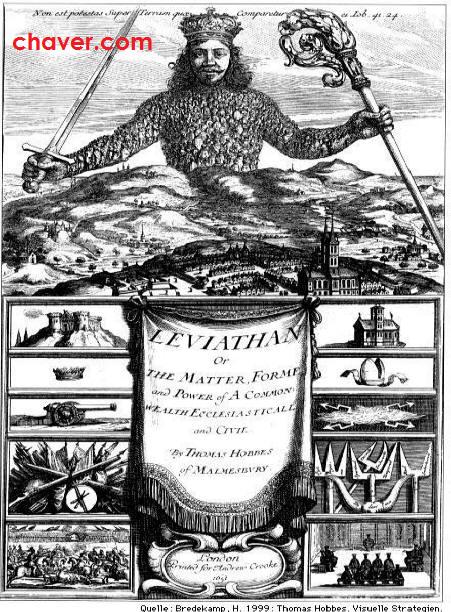
The Leviathan holds the symbol of civil power in his right hand (left side of the page) and ecclesiastical power in his left hand (right side). Below are two columns of five illustrations each. Every illustration corresponds to the one opposite it, creating five pairs. Each pair shares a theme; each column follows its own logic. Every individual image gains meaning from its position at the intersection of row and column.
This is the first principle of woven text: the individual element exists at the intersection of two planning lines, like a point on a Cartesian grid defined by its x and y coordinates. The same principle—but with far greater sophistication—operates in the Torah and Mishnah.
Where to Go Next
- Torah Weave Project — Maps and texts of all 86 units, and the commentaries
- Genesis Map — The 3×7 weave of Genesis's 19 units
- Download "Before Chapter and Verse" — All 86 Torah units in woven format (free PDF)
- The Decalogue — The archetypal woven text explained
- Mishnah Portal — The structured Mishnah